

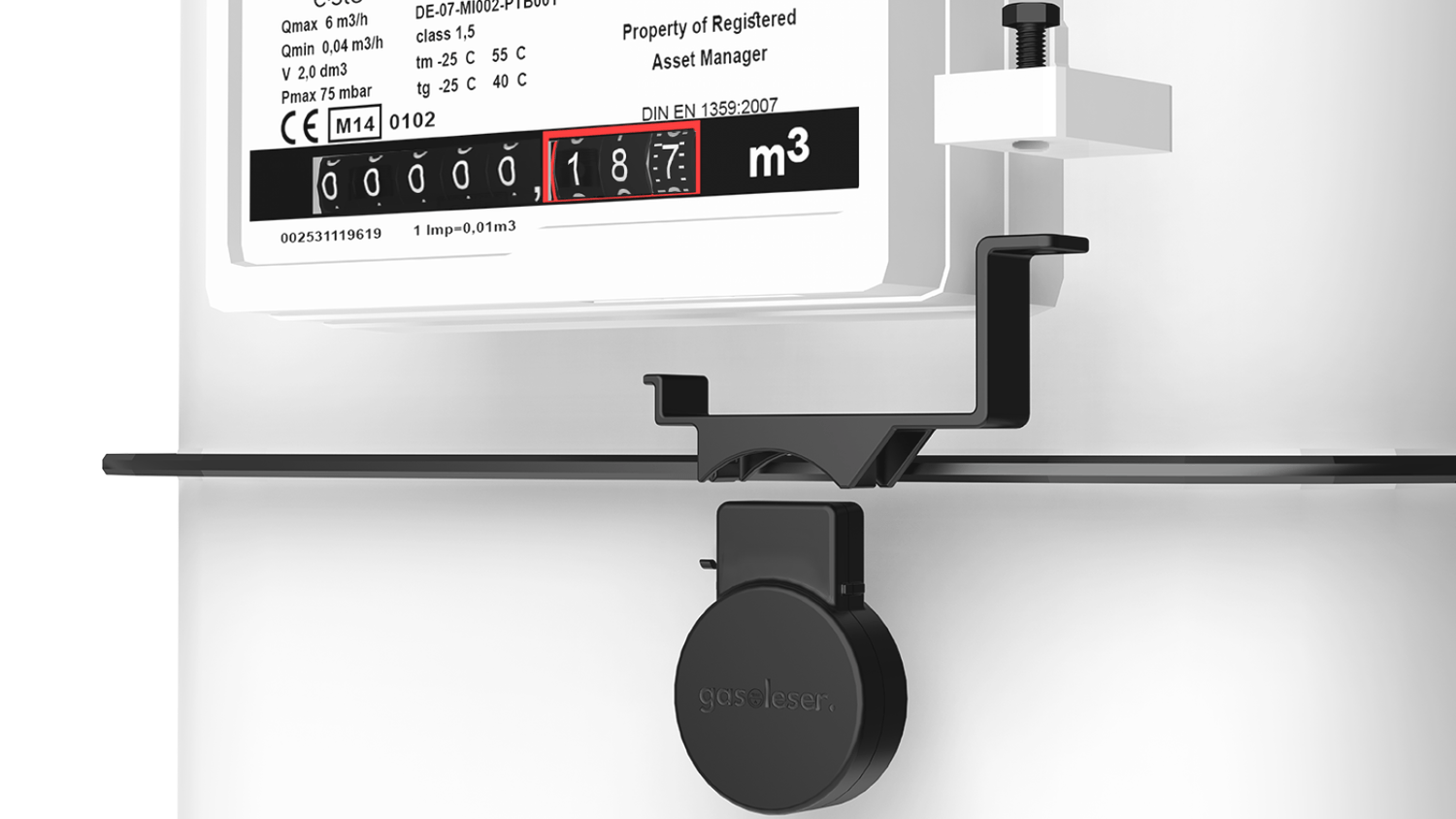
Whether for heating, cooking, or hot water – gas is a key energy source in many households. Yet hardly anyone regularly checks their gas meter. It's crucial for accurate billing of your gas consumption and helps you control costs and identify potential savings.
This article explains how a gas meter works, what types exist, how to read it correctly – and how to deal with the gasleser allows you to easily record consumption digitally.
What is a gas meter – and why is it important?
A gas meter measures the amount of gas flowing through your house's gas line. The recorded consumption is displayed in cubic meters (m³) This is specified and forms the basis for the annual billing – but not directly: For billing purposes, the volume is measured in kilowatt hours (kWh) converted. This conversion is based on two factors:
- Calorific value : Indicates how much energy is contained in the gas (kWh/m³)
- State number : Corrects consumption to standard conditions (temperature, pressure, altitude)
Example calculation:
750 m³ × calorific value 10.5 × state factor 0.98 = 7,717.5 kWh
Without a functioning gas meter, neither a fair cost comparison nor a transparent billing would be possible – neither for you nor for the energy supplier.
Gas meter functionality: Structure and technology in detail
A gas meter has a clear structure: The flowing gas moves mechanical elements such as diaphragms, pistons, or turbine wheels. The speed of the gas flow generates a rotary motion, which appears in the meter as cubic meters of gas (m³). Some models use a second measuring chamber for greater accuracy.
Digital versions use a pulse sensor and enable remote meter reading. In industry and commerce, volume converters or quantometers are also used. The precise determination of gas consumption is carried out according to standardized procedures – both in households and in commercial transactions.

Where can I find the gas meter?
Depending on the type of building, the gas meter is located in different places:
- Single-family home : usually in the basement or utility room
- Apartment building : often in the utility room, hallway or stairwell
- Apartment : in the case of separate apartment meters, sometimes directly in the apartment
Tip: The gas meter number is marked on the device – it is needed, for example, for the annual meter reading report.
Reading the gas meter – step by step
At least once a year or when moving house, you must submit the meter reading to your energy supplier – but you can also read the gas meter yourself at any time if you want to monitor your gas consumption or specifically identify potential savings.
Here's how it works:
- Search for counter (see above)
- Check meter number (especially with multiple devices)
- Only the black digits before the decimal point note
- Optional: a photo to document
- Submit meter reading – online, via app or by phone

Gas heating and gas meter: The important interplay in everyday life
Your gas meter is closely linked to your gas heating system. While the heating system generates heat for your home, the meter precisely measures gas consumption in cubic meters (m³). These readings serve as the basis for your bill and show you how efficiently your heating system is operating.
Especially in times of rising energy prices, it's worthwhile to keep an eye on the relationship between heating habits and gas meter readings. This way you can identify potential savings and actively reduce your heating costs.
What types of gas meters are there?
Different types are used depending on the consumption volume and location. The four most common are:
Diaphragm gas meter (diaphragm meter) - standard in households:
The diaphragm gas meter (BK meter) is the standard device in private households. The gas flow moves flexible diaphragms that measure the volume flowing through. Simple, robust, and reliable for low to medium consumption.
Tip: Do you want to read your gas meter digitally? Then the gasleser is the ideal solution!
What the gas reader offers:
- Digital consumption tracking in real time
- Graphical representation of consumption
- No more manual readings required
- Easy retrofit to existing - BK meters
- Ideal for controlling, optimizing and reducing your gas consumption
This way you can keep track of your gas consumption at all times – directly on your smartphone.
With the stromleser app, you can track your current consumption in real time , view consumption histories, and even activate custom notifications – for example, if your daily consumption is unusually high. The clear graphs help you better understand your usage patterns and save energy in a targeted way.
The gas meter is particularly helpful in the face of rising energy prices and the desire for more sustainability in everyday life.
Here you can find step-by-step instructions for installing the gas reader.

Rotary piston counter:
Used in areas with high gas consumption (e.g., industrial plants). Two counter-rotating pistons mechanically measure the gas volume.
Turbine counter:
Suitable for very high gas flow rates. An internal turbine is driven by the gas flow – its rotational speed corresponds to the flow rate.
Ultrasonic counter:
Modern, contactless measurement using ultrasonic waves. Particularly precise, durable, and insensitive to dirt or moisture – ideal for digital applications.
Choosing the right meter – which one suits your needs?
Choosing the right meter depends on individual consumption and the application. For private households, a small diaphragm gas meter (e.g., G10) is usually sufficient. In apartment buildings, commercial properties, or industrial settings, however, larger models such as turbine gas meters with flow converters are used to accurately measure even high flow rates.
Legal requirements & meter replacement
According to the German Measurement and Calibration Act (MessEG), every household must be equipped with a calibrated gas meter. The metering point operator (usually the same as the network operator) is responsible for installation, maintenance, and replacement.
A gas meter is usually replaced every eight years. The replacement is free of charge and will be announced in writing beforehand.
Safety around the gas meter
- If you smell gas: Immediately close the main valve, open windows, leave the building, call emergency services (112) or contact the gas emergency service.
- No tampering: The gas meter is the property of the network operator – never work on the device yourself.
Conclusion
A functioning gas meter is essential for accurate billing, monitoring your energy consumption, and identifying potential savings. Whether for annual meter readings, moving house, or regular self-monitoring – keeping track of your gas consumption allows you to actively reduce costs and use energy more consciously.
With the gas reader from energieleser, it's even easier: You can digitally read your analog BK gas meter, conveniently monitor consumption via app and efficiently analyze your gas usage – without any modifications or meter changes.
Especially in times of rising gas prices and growing awareness of sustainability, switching to digital consumption monitoring is worthwhile. This way you not only maintain an overview, but can also optimize your gas consumption – simply, transparently and smartly.
Frequently Asked Questions (FAQ)
How often do I need to read my gas meter?
At least once a year or when moving house. Manual reading is not necessary with digital or smart meters.
Who is responsible for the gas meter?
The metering point operator (often identical to the network operator) provides the meter and takes care of maintenance and replacement.
Does replacing a gas meter cost money?
No. Scheduled meter replacement after the calibration period expires is free of charge. Costs only arise in cases of damage caused by improper use.
What to do if the gas meter is defective?
Inform your energy supplier or network operator – the meter will be checked free of charge and replaced if necessary.
How can I read my gas meter digitally?
With the gas reader, you can easily retrofit your analog gas meter and digitally record your consumption – without the need for an expensive meter replacement. The device is attached to your existing diaphragm gas meter and automatically reads the meter readings. The data is transmitted securely and can be conveniently viewed via an app – including detailed consumption graphs, trends, and analysis.




Leave a comment
This site is protected by hCaptcha and the hCaptcha Privacy Policy and Terms of Service apply.